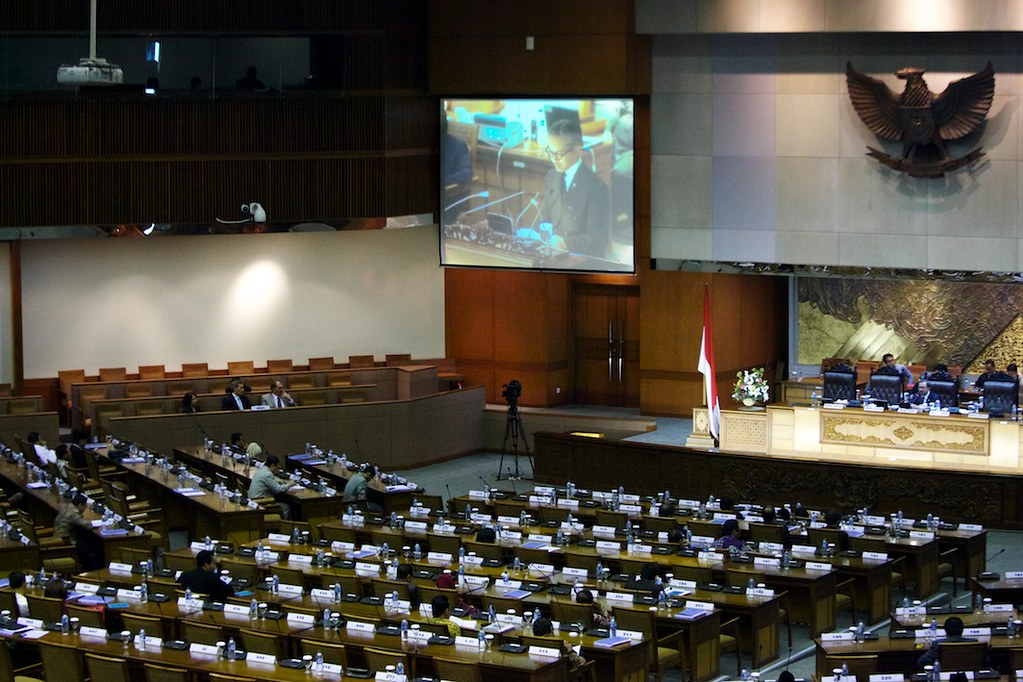
Photo: "Indonesia ratifies the CTBT" by The Official CTBTO Photostream, BY via Openverse
What's Actually Powering Indonesia's Turn Toward Strongman Rule? It's Not the Man in Charge
A wave of party defections, a military remilitarization drive, and a sovereign wealth fund answering to one man alone are being described not as one leader's power grab, but as symptoms of a party system built to produce leaders no one can constrain, according to an analysis published by East Asia Forum.
The analysis argues that Indonesia's authoritarian revival has been enabled less by the ambitions of individual presidents than by the way the country's political parties evolved since democracy stabilized in the 2000s: into personalistic, "catch-all" vehicles built around a single figure rather than a program. Gerindra, the analysis states, exists to serve President Prabowo Subianto. Nasdem was built around tycoon Surya Paloh. The Democratic Party is inseparable from the family of former president Susilo Bambang Yudhoyono. Hanura was former military commander Wiranto's vehicle. Even the PDI-P — the party most closely tied to Sukarno-style ideology and, per the analysis, anchored by a more prominent cadre structure and social base — has grown increasingly dynastic under former president Megawati Sukarnoputri and her daughter, Puan Maharani. The analysis's core claim is structural: when a governing coalition is built entirely from parties like these, there is no institutionalized, policy-driven member of that coalition with the incentive or capacity to impose horizontal constraints on the executive.
Jokowi and Prabowo, the analysis contends, arrived at that same structural opening from different directions. Jokowi built personalized power partly outside party structures — leveraging state-owned enterprises and bureaucracies to install loyalists, while volunteer networks like Pro-Jokowi and Tim Pemenangan Nasional redirected voter loyalty toward him personally and away from PDI-P, the party that had built his career. His endorsement of his son, Gibran Rakabuming, as Prabowo's running mate — in open defiance of PDI-P — is presented in the analysis as the clearest signal that his personal network had outgrown the party that sponsored him. Prabowo's presidency, by contrast, is described as the more "textbook" case: a leader whose own party was built to serve him from the start, reinforced by what the analysis calls extra-party levers — the military and Danantara, Indonesia's sovereign wealth fund, whose governing boards are appointed and dismissed solely at his discretion.
If that framing holds, the two presidencies look less like a shared personality trait and more like two different exploits of the same unlocked door — one running power through captured state agencies, the other through a party with no independent identity to begin with. The analysis ties this to concrete developments under Prabowo: a first-year administration it describes as showing systemic indicators of remilitarization, proceeding with little to no parliamentary resistance, alongside a narrowing of space for civil society as criticism from non-governmental organizations has been cast, in the analysis's account of Prabowo's own framing, as foreign-funded interference and anti-nationalist agitation. Both presidents, the analysis notes, also absorbed rival parties into their coalitions — Jokowi brought in Gerindra and the Democratic Party, while Prabowo has folded in Nasdem and the National Awakening Party — a pattern the analysis says blurs the line between legislature and executive rather than preserving it.
The analysis's own prescription underscores how structural its diagnosis is: reversing the trend, it argues, requires rebuilding party institutionalization itself — revising electoral and political party laws to reward programmatic competition and internal democracy over patronage networks — rather than relying on regular elections alone. Read against the party-by-party detail in the analysis, that argument suggests the current alignment of Gerindra, Danantara, and a quiescent parliament is not a one-off configuration but a repeatable one: without changes to how parties are built, the analysis warns, each election cycle risks producing not renewal but a new personalistic vehicle running the same unobstructed road.